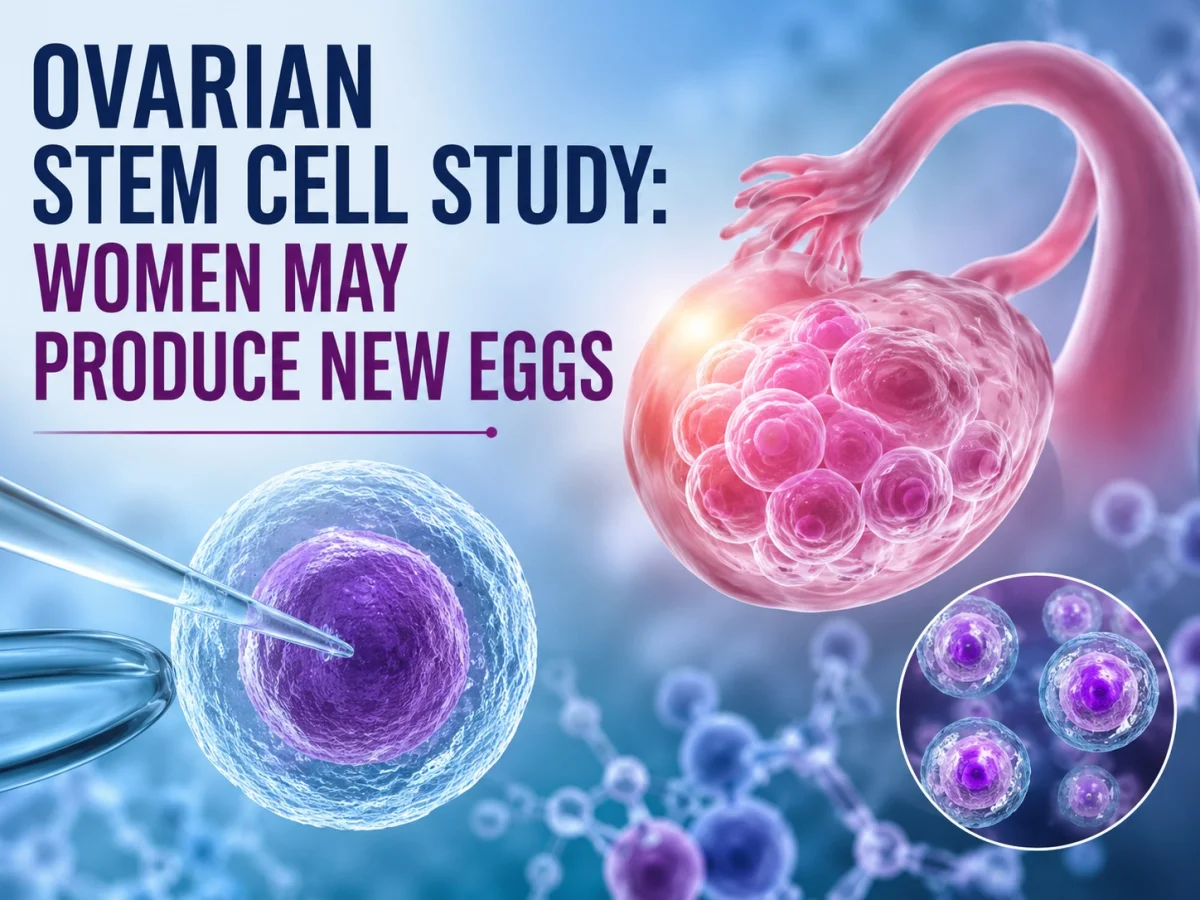
Ovarian Stem Cell Study: Women May Produce New Eggs
For more than half a century, one idea has shaped how we understand female fertility:Women are born with all the eggs they will ever have.Unlike men, who continue producing sperm throughout adulthood, women are traditionally thought to have a fixed supply of eggs established before birth. That supply declines with age, eventually contributing to menopause.But research on ovarian stem cells has challenged this long-standing idea.Scientists have reported rare cells in adult ovaries that appear capable of developing into new egg cells, or oocytes. A 2022 study led by researchers at Northeastern University provided further evidence for these cells in adult human ovarian tissue.If confirmed and eventually shown to be functional, the finding could fundamentally change how scientists think about ovarian aging, diminished ovarian reserve and female infertility. But there is an important catch.This does not mean women can currently regenerate their eggs or that ovarian stem cells are an available infertility treatment.The science is still being debated.Do women have a fixed egg supply?The conventional understanding of female reproductive biology is relatively simple.Egg cells begin forming during fetal development. Before birth, immature eggs become enclosed within structures called primordial follicles, which form the woman's ovarian reserve.After birth, the number of these follicles gradually declines.A 2008 review by reproductive biologist Teresa Woodruff summarized the prevailing evidence at the time: the female germ-cell pool was considered non-renewable, with the eggs formed before birth providing the reproductive supply from puberty through menopause.This is also why ovarian reserve matters so much in fertility.Tests such as AMH and antral follicle count can provide information about the remaining follicle pool, although ovarian reserve tests cannot tell a woman exactly how many eggs she has or whether she will become pregnant.Scientists discover follicular renewalIn 2004, researchers led by Jonathan Tilly reported something that challenged this model.Working with adult mice, they identified cells with characteristics of germline stem cells and reported evidence that these cells could contribute to the formation of new ovarian follicles after birth.The study, published in Nature, was titled “Germline stem cells and follicular renewal in the postnatal mammalian ovary.”The implication was enormous.If adult ovaries contained stem cells capable of generating new eggs, the ovarian reserve might not be completely fixed after birth.The finding triggered intense debate in reproductive biology.Some researchers questioned whether the cells being identified were genuinely germline stem cells and whether the experiments demonstrated true egg production.Others continued investigating the possibility.The debate moved from mice to human ovaries.In 2012, Tilly and colleagues reported evidence of similar cells in human ovarian tissue.The researchers isolated rare cells from ovarian cortex obtained from women of reproductive age. They called them oogonial stem cells, or OSCs.In laboratory experiments, the cells could be expanded and were reported to spontaneously generate cells with the characteristics of oocytes.The researchers also reported that human OSCs introduced into human ovarian tissue produced follicles containing oocytes after the tissue was transplanted into mice. That was an important distinction.The researchers were not simply finding an immature egg sitting inside an ovary. They were reporting a population of cells that could proliferate and give rise to cells resembling oocytes.But there was still a major question:Were these cells actually part of a natural egg-producing system inside the adult human ovary?The study that contradicted stem cell evidenceThe ovarian stem cell hypothesis faced substantial opposition. One particularly important challenge came in 2020.Researchers analyzed more than 24,000 cells from human ovarian cortex samples from 21 patients using single-cell transcriptomic and cell-surface profiling. They identified several major ovarian cell populations but concluded that the cells previously isolated using the DDX4 marker were perivascular cells, not oogonial stem cells.Their conclusion was direct: their data did not support the existence of germline stem cells in adult human ovaries.If correct, that would support the traditional model of a limited ovarian reserve.So, the question remained unresolved.2022 Northeastern study on producing new eggs.In 2022, researchers from Northeastern University and collaborating institutions revisited the question.Their study, published in Stem Cells, used single-cell RNA sequencing to examine adult human ovarian cortex and focused specifically on whether the analytical methods being used could cause rare germline cells to be missed or misclassified.They reported finding rare germline cells with gene-expression profiles consistent with oogonial stem cells.Importantly, the researchers said these cells had gene-expression patterns distinct from other ovarian cells, including the perivascular cells identified in the 2020 study.They also reported evidence of germ cells undergoing meiosis I — an important stage in the development of reproductive cells.In other words, the researchers argued that the earlier failure to identify ovarian stem cells may have been partly related to how the cells were isolated and analyzed.The finding reopened the debate: Can women really make “new eggs”?This is where the headline needs some context.When researchers say ovarian stem cells may produce new eggs, they are not saying that women are continuously making mature eggs throughout life in the same way men continuously produce sperm.The proposed process is much more complicated.The hypothesis is that rare germline stem cells may exist in the adult ovary and could potentially enter the developmental pathway that produces oocytes.But producing an oocyte-like cell is not the same thing as producing a healthy, mature human egg.A functional human egg must:complete the necessary stages of meiosishave the correct number and organization of chromosomesmature properlybe capable of normal fertilizationsupport normal embryo developmentThose are much higher hurdles.What has actually been demonstrated? QuestionCurrent evidenceHave rare stem-like germ cells been reported in adult human ovaries?YesHave researchers reported generating oocyte-like cells from human ovarian stem cells in laboratory conditions?YesHas evidence of germ cells undergoing meiosis been reported in adult human ovarian tissue?YesHas it been proven that these cells naturally replenish a woman's ovarian reserve throughout life?NoHas it been proven that they routinely produce mature, fertilizable human eggs?NoHas a baby been born using an egg generated from a woman's ovarian stem cells?NoIs ovarian stem cell therapy an established infertility treatment?NoThat distinction is critical.The 2022 study provides evidence supporting the existence of these rare cells and early stages of their differentiation. It does not establish that adult women naturally replenish their egg supply in a clinically meaningful way.Why could ovarian stem cells matter for infertility?If the ovarian stem cell hypothesis is eventually proven, the implications could be substantial.Diminished ovarian reserveToday, women with diminished ovarian reserve may have fewer recruitable follicles and may respond differently to ovarian stimulation during IVF.An ability to generate new oocytes would represent a completely different biological approach to the problem.Age-related fertility declineFemale fertility declines significantly with age, partly because both the number and quality of available oocytes change.Understanding whether regenerative cells exist in the adult ovary could give researchers another way to investigate ovarian aging.The question would not simply be how many follicles remain.It would also be whether the ovary contains cells with regenerative potential — and what happens to them as the ovary ages.Premature ovarian insufficiencyFor women who experience premature ovarian insufficiency, understanding whether ovarian stem cells remain present but inactive could eventually open new avenues of research.That does not mean stem cells can currently restore ovarian function.It means they could potentially become part of a future research strategy.Fertility preservationThe implications could also extend to women whose ovaries have been damaged by chemotherapy or other medical treatments.Current fertility-preservation methods include egg and embryo freezing and, in selected cases, ovarian tissue cryopreservation. Freezing your eggs is a difficult decision if you don’t have a partner yet or are uncertain of your desire to have kids later. It is also quite expensive. We have large numbers of women going to Mexico for egg freezing or to Asian destinations such as Malaysia or Thailand.Stem-cell-based approaches would be fundamentally different because they could potentially aim to generate new reproductive cells rather than preserve existing ones.Can ovarian stem cells be turned into new eggs now?This research should not be interpreted as a new fertility treatment.A woman with low AMH cannot currently go to a clinic and have her ovarian stem cells turned into healthy new eggs.The research does not prove that menopause can be reversed. It does not prove that ovarian reserve can currently be increased.It does not mean women should delay egg freezing because new eggs may eventually become available.And it does not establish that treatments marketed as “ovarian rejuvenation” or “stem-cell fertility therapy” can restore fertility. Some clinics do offer ovarian rejuvenation with PRP, but that is not as efficient as producing entirely new eggs from stem cells.Those are separate claims requiring clinical evidence.Why the controversy actually matters?At first glance, the disagreement between the 2020 and 2022 studies may seem like scientists simply arguing over terminology.It is more important than that.The disagreement is about what cells actually exist inside the adult human ovary.The 2020 study analyzed more than 24,000 cells and concluded that the supposed ovarian stem cells were actually perivascular cells.The 2022 Northeastern-led study argued that optimized analysis could distinguish rare germline cells from those perivascular cells and reported evidence consistent with ovarian stem cells.Until independent researchers can reproduce these findings and demonstrate what these cells actually do, the question remains open.That is exactly how science is supposed to work.So, can women produce new eggs?Possibly. But science has not proved that adult women naturally produce enough new eggs to replenish their ovarian reserve or restore fertility.What researchers have found is more subtle and, arguably, more interesting.There is evidence that rare cells with characteristics of ovarian stem cells may exist in adult human ovaries. Some research suggests these cells can enter the pathway toward oocyte formation.Other research disputes their existence.And even if these cells are definitively shown to be genuine ovarian stem cells, researchers still need to demonstrate that they can produce healthy, mature, fertilizable human eggs and ultimately support healthy pregnancies.That is a long way from the laboratory to the fertility clinic.But if that final step is ever achieved, it could change one of the most fundamental assumptions in reproductive medicine: that a woman's lifetime supply of eggs is fixed before she is born.